
You have seen the table before. A firm lays its three offerings side by side against everything else, and its own products win every row. Highest returns, lowest risk, best liquidity, most tax-efficient. Nobody believes it. A sophisticated reader spots it in about four seconds and stops reading, because a table where the author wins every column isn’t analysis, it’s a brochure with borders.
So here is ours, and ours loses.
Private credit loses the upside row. Real estate loses on liquidity and effort. Private equity loses on downside protection, and loses it badly. Those aren’t flaws we’re confessing to. They’re the defining features of each asset class, and they’re the reason all three exist at once. If one of them were simply better, the other two would have disappeared a long time ago.
We invest across all three. Not because we can’t decide, but because they answer different questions.
The cleanest way to think about a private markets portfolio is not as a ranking but as a set of layers, each doing a job the others can’t do well.
Private credit is the income layer. It answers: what pays me while I wait? It’s the layer that funds life, covers obligations, and keeps you from being a forced seller of the other two at the worst possible moment.
Real estate is the hedge layer. It answers: what protects my purchasing power? Hard assets with rents that reset and debt that inflation quietly erodes, plus a tax code that treats real property more generously than almost anything else you can own.
Private equity is the growth layer. It answers: what actually compounds? No coupon, no collateral, no promised exit — just the possibility that the business is worth multiples of what you paid because of work that gets done after you buy it.
Income, hedge, growth. Three different jobs. Ranking them against each other is like ranking a roof against a foundation.
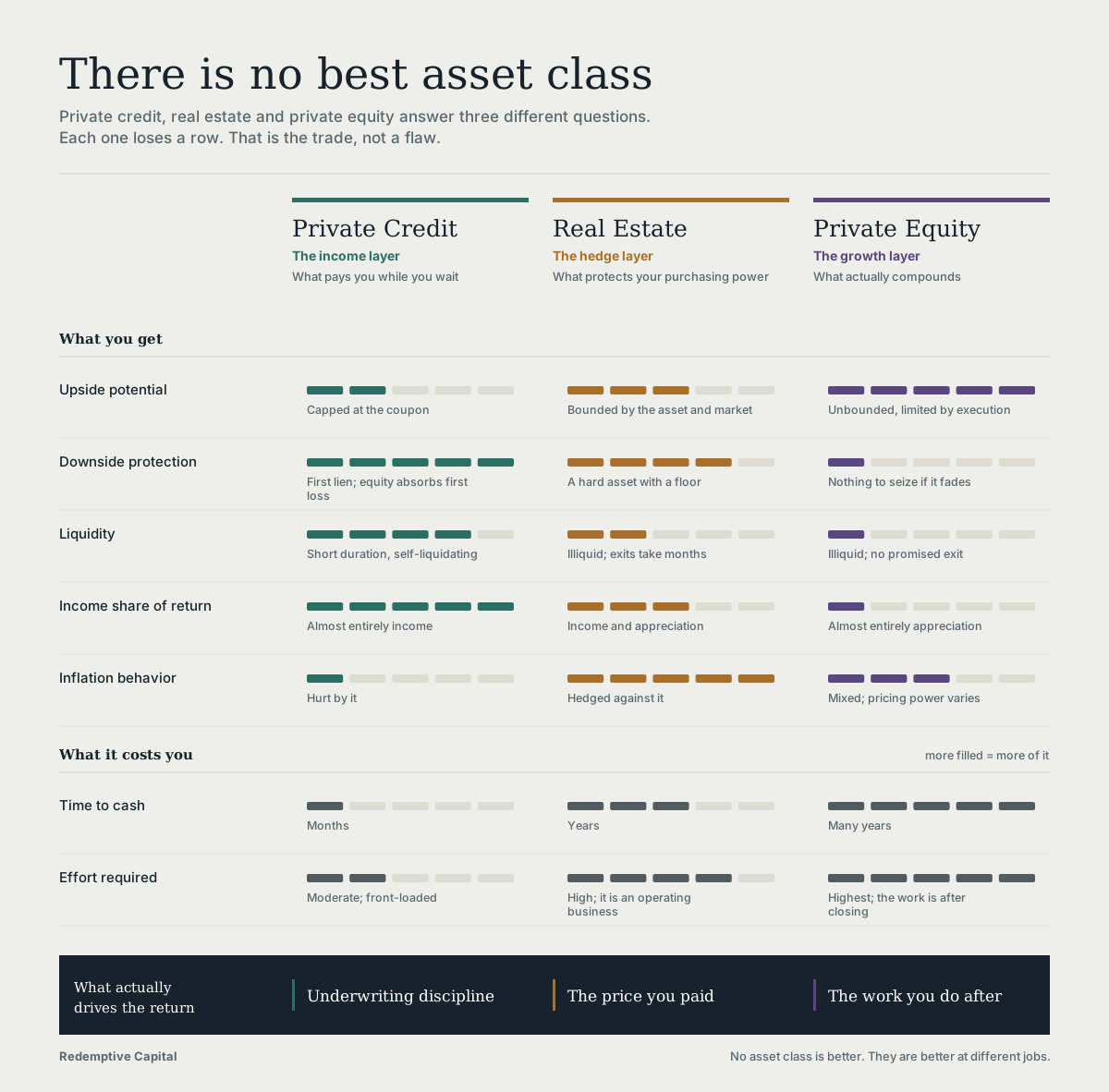
Read down the columns rather than across the rows. Each column is internally consistent: the thing that gives an asset class its strength is the same thing that creates its weakness. That’s not a coincidence, it’s the trade.
What it’s for. Current income, short duration, and a defined outcome. You know what you’re getting and roughly when.
Where it wins. Position in the capital stack. As a first-lien lender you are first in line, and the borrower’s equity absorbs the first loss before your dollar is touched. If the deal goes sideways, you have a collateral remedy — an actual asset, with a legal process attached to it. Duration is short, so capital comes back and can be redeployed, and the loan repays itself rather than requiring you to find a buyer.
What you give up. Everything above the coupon. If a borrower buys a property at a spectacular price and triples his money, you get your interest and your principal, and that’s it. You will never be pleasantly surprised by a loan. Inflation works directly against you — you are paid back in dollars worth less than the ones you lent, and a fixed coupon has no mechanism to catch up. In taxable accounts, interest is ordinary income, which is the least favorable treatment in the code. And when rates fall, the good loans repay first, leaving you to reinvest at worse terms.
Who it’s wrong for. Anyone whose real goal is compounding wealth rather than generating income. Credit preserves and pays. It does not multiply.
The return driver is underwriting discipline, which is another way of saying the money is made or lost before the wire goes out. Nothing you do afterward improves a bad loan.
What it’s for. Inflation protection, tax efficiency, and a blend of income now and appreciation later.
Where it wins. It’s a hard asset with a floor — land and structures retain value even when the operating story disappoints. Rents reset as prices rise while fixed-rate debt stays fixed, so inflation transfers value from your lender to you. The tax treatment is genuinely unusual: depreciation shelters income you actually received, cost segregation accelerates it, and 1031 exchanges defer gain on the way out. It’s the only one of the three where the tax code is a meaningful part of the return.
What you give up. Liquidity and time. Selling is a months-long process with real friction, and the market decides your timing more than you do. It’s capital-intensive, and the leverage that magnifies the upside magnifies the downside just as efficiently. Most of all, it’s operationally heavy — tenants, maintenance, insurance, taxes, contractors, vacancy. Buying a building means buying a small operating business whether you wanted one or not.
Who it’s wrong for. Anyone who needs their capital back on a schedule, and anyone who thinks of it as passive.
The return driver is the price you paid. You can operate well and still lose on an overpriced deal, and you can operate adequately and still win on a cheap one. Basis forgives a great deal.
What it’s for. Growth without a ceiling. It’s the only layer where the outcome isn’t bounded by a contract or a comparable sale.
Where it wins. Upside is limited by execution rather than by structure. A business bought at a reasonable multiple that grows earnings and re-rates on exit can return several times the capital, and unlike a loan there is no coupon defining the top. Operating improvements compound in a way that no other asset class replicates.
What you give up. Protection, and years of your life. If the business deteriorates, there is no collateral to seize and no floor underneath you — equity is last in line, and last in line sometimes means zero. Holds run for years with no promised exit, and the distribution of outcomes is wide, with the gap between good and bad operators far larger here than in credit or real estate. Returns arrive mostly at the end, so you fund the wait out of something else.
Who it’s wrong for. Anyone who needs certainty, anyone who needs cash flow, and anyone unwilling to be involved.
The return driver is the work you do after closing. Buying well matters; it just doesn’t finish the job.
Look again at one row in particular: effort required. Moderate, high, highest.
This is the row we’ve never seen in someone else’s comparison, and it’s the most useful one, because it tells you what you’re really buying.
With private credit you are buying discipline at the front end — real underwriting, real documents, real collateral verification — followed by a relatively quiet holding period. The work is concentrated and finite.
With real estate you are buying an operating business, and either you run it or you pay someone competent to run it. The work never fully stops. Returns that assume a passive experience usually assume a manager you haven’t hired yet.
With private equity you are buying an obligation to show up for years. The upside doesn’t exist independently of that obligation. It is the obligation.
The honest version of “which asset class performs best” is closer to “how much of yourself are you prepared to put into it?” An allocator who wants the returns of the growth layer but the involvement of the income layer is going to be disappointed by something.
Usually more than one, and the mix follows your circumstances rather than a ranking.
The starting questions are practical. How much of your capital needs to come back within the year? What does your tax situation actually reward? How much time and attention can you commit, honestly rather than aspirationally? And what will you do in the year everything is marked down at once?
A few patterns show up repeatedly. Income without a growth layer erodes in real terms, slowly enough that it’s easy to miss. Growth without an income layer forces you to sell good assets at bad moments to cover ordinary life. And most people over-own the layer that matches their temperament — the cautious build a portfolio entirely out of first liens, the optimistic build one entirely out of equity — and then experience the resulting concentration as a surprise.
Layering isn’t hedging your convictions. It’s acknowledging that a portfolio has to do more than one job at once.
We treat capital as entrusted rather than owned, and entrusted capital deserves the version of the story that includes what can go wrong. A table where our own offerings win every row would be easier to write and worth less than nothing to read.
Private credit has capped upside. Real estate is illiquid and it’s work. Private equity can go to zero. All three are still worth owning, for different reasons, in different proportions, by different people.
This is educational content about asset class characteristics, not investment advice or an offer to sell securities. Any specific investment involves risks not covered here, including loss of principal. Consult your own advisors regarding your situation.